
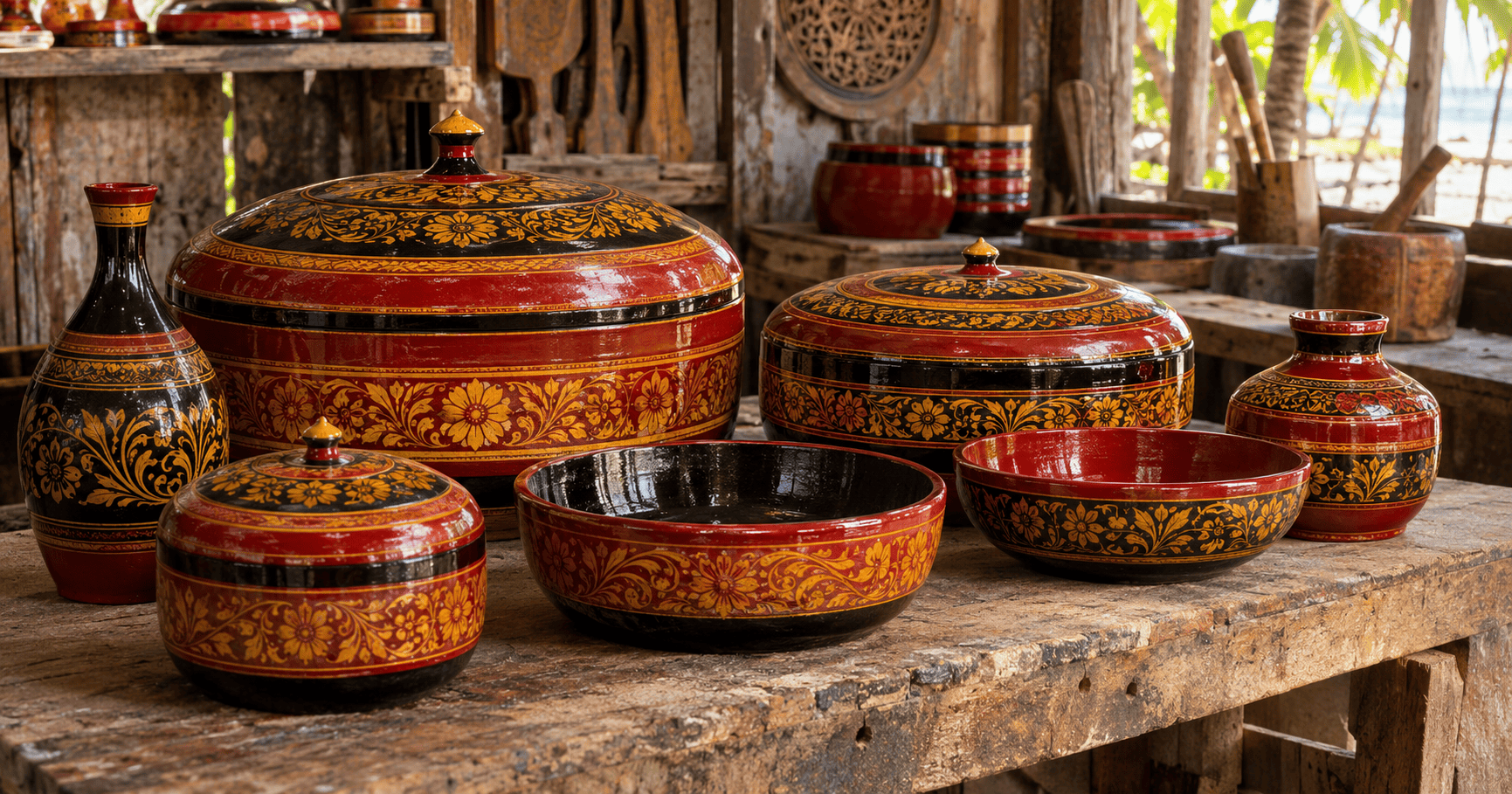
From ordinary pieces of wood to extraordinary works of art, the centuries-old tradition of Liyelaa Jehun reflects the creativity, patience and craftsmanship of the Maldivian people.
In a quiet workshop, a piece of wood begins to turn.
A craftsman carefully shapes its surface, guiding a simple tool against the spinning timber. Gradually, an ordinary block becomes a beautifully formed container.
Then comes the colour.
Layers of red, black and yellow lacquer transform the wooden surface into something remarkable. Intricate patterns emerge, polished to a brilliant shine.
This is Liyelaa Jehun, one of the Maldives’ most distinctive traditional crafts.
Long before modern manufacturing and imported decorative goods became common, Maldivian artisans were producing exquisite handcrafted objects using skills passed from one generation to another.
Today, this remarkable art form remains a symbol of the country’s cultural identity.
A Tradition Rooted in History
The origins of Maldivian lacquerwork are not precisely documented, but the craft has a long history connected to the country’s maritime trading relationships.
For centuries, the Maldives maintained commercial and cultural connections with countries across Asia.
Lacquerworking techniques may have reached the islands through these historical trading networks, particularly through connections with East and South Asia.
Over time, Maldivian artisans developed their own distinctive techniques, colours and decorative styles.
What emerged was a craft recognised for its carefully shaped wooden objects, glossy surfaces and intricate patterns.
Lacquerwork became more than a decorative activity. It was used to produce household objects, ceremonial containers and architectural decorations.
Its influence can also be seen in the wooden elements of historic Maldivian coral stone mosques, where lacquered surfaces contribute to the richness of traditional craftsmanship.
From Wood to Work of Art
Creating a traditional lacquered object requires considerable skill.
The process begins with selecting suitable timber. One of the woods traditionally used is funa, commonly known as Alexander laurel.
The wood is cut and shaped, often using a lathe that rotates the material while a craftsman carefully works its surface.
In the traditional process, the lathe could be operated manually using a rope mechanism.
Once the wooden object takes its desired shape, layers of coloured lacquer are applied.
Red, black and yellow are the traditional colours most strongly associated with Maldivian lacquerwork.
The lacquer is carefully heated and prepared before application. The surface is then polished, traditionally using dried leaves, to create its characteristic smooth and glossy appearance.
The final stage requires exceptional precision.
Using simple tools, the craftsman engraves decorative patterns into the lacquered surface, revealing contrasting colours beneath.
These patterns are often created without prepared drawings or stencils.
Every finished piece reflects the experience, concentration and artistic judgement of the person who made it.
Thulhaadhoo and the Preservation of a Craft
Among the islands of the Maldives, Thulhaadhoo in Baa Atoll holds a special place in the history of lacquerwork.
The island has long been recognised for its skilled lacquer craftsmen, whose work helped preserve the tradition when the craft declined elsewhere.
For generations, knowledge was shared within families, with younger artisans learning by observing and assisting experienced craftsmen.
Traditional lacquerware from Thulhaadhoo includes decorative containers, bowls, jewellery boxes, vases and other carefully crafted wooden objects.
Each piece represents hours of meticulous work.
In an age when many products can be manufactured rapidly and inexpensively, the handmade nature of Liyelaa Jehun gives these objects a distinct cultural value.
Their significance lies not simply in their appearance, but in the knowledge required to produce them.
More Than Decoration
Historically, Maldivian lacquerware served practical as well as decorative purposes.
Small containers were used to store jewellery, personal belongings and valuable household items.
Larger containers had important roles in traditional gatherings and ceremonial occasions.
One particularly significant example was the malaafaiy, a large ornamental food container associated with communal and ceremonial dining.
Such objects were valued for their craftsmanship and their role in social traditions.
Lacquerwork was also used to decorate architectural features, including wooden beams and columns.
These applications demonstrate how deeply craftsmanship was integrated into Maldivian daily life.
Art was not always something displayed separately from ordinary activities.
It was part of the objects people used, the buildings they occupied and the traditions they practised.
A Heritage Worth Protecting
Like many traditional crafts around the world, Liyelaa Jehun faces challenges in the modern era.
Mass-produced goods, changing consumer preferences and the limited number of traditional practitioners have placed pressure on the continuation of the craft.
Producing an authentic lacquered object takes time, patience and specialised knowledge.
Passing these skills to younger generations requires more than preserving finished products.
It requires opportunities for people to learn the techniques themselves.
Efforts to document the craft, promote authentic handmade products and connect artisans with new markets can contribute to its continued survival.
Tourism also presents an opportunity.
Visitors interested in Maldivian culture can discover craftsmanship beyond the familiar images of beaches and resorts.
Supporting genuine local artisans helps preserve traditional knowledge while creating economic opportunities within island communities.
Keeping Traditional Skills Alive
The story of Liyelaa Jehun raises a broader question about cultural preservation.
What happens when the last person who understands a traditional skill is no longer able to practise it?
Books, photographs and museum collections can preserve valuable information.
But craftsmanship also depends on experience.
It lives in the movement of a craftsman’s hands, the ability to judge materials and the understanding developed through years of practice.
Preserving these abilities requires continued teaching, practical opportunities and recognition of their cultural importance.
The Maldives possesses a rich heritage of traditional arts, including mat weaving, wood carving, lacquerwork and other forms of craftsmanship.
Each tells a different story about the creativity and resourcefulness of earlier generations.
Together, they form part of the nation’s cultural identity.
A Legacy in Every Pattern
A beautifully lacquered wooden container may appear to be a simple decorative object.
But behind its polished surface lies a story of historical connections, inherited knowledge and artistic dedication.
Every curve reflects the skill of the craftsman.
Every colour carries a tradition.
Every engraved pattern represents knowledge that has survived across generations.
Liyelaa Jehun is more than an art form from the Maldives’ past.
It is a living reminder of what Maldivian hands can create.
And by preserving these skills today, we help ensure that the beauty of Maldivian craftsmanship remains part of tomorrow.
Have any thoughts?
Share your reaction or leave a quick response — we’d love to hear what you think!
-
 1
-
 0
-
 0
-
 0
-
 0
-
 0