
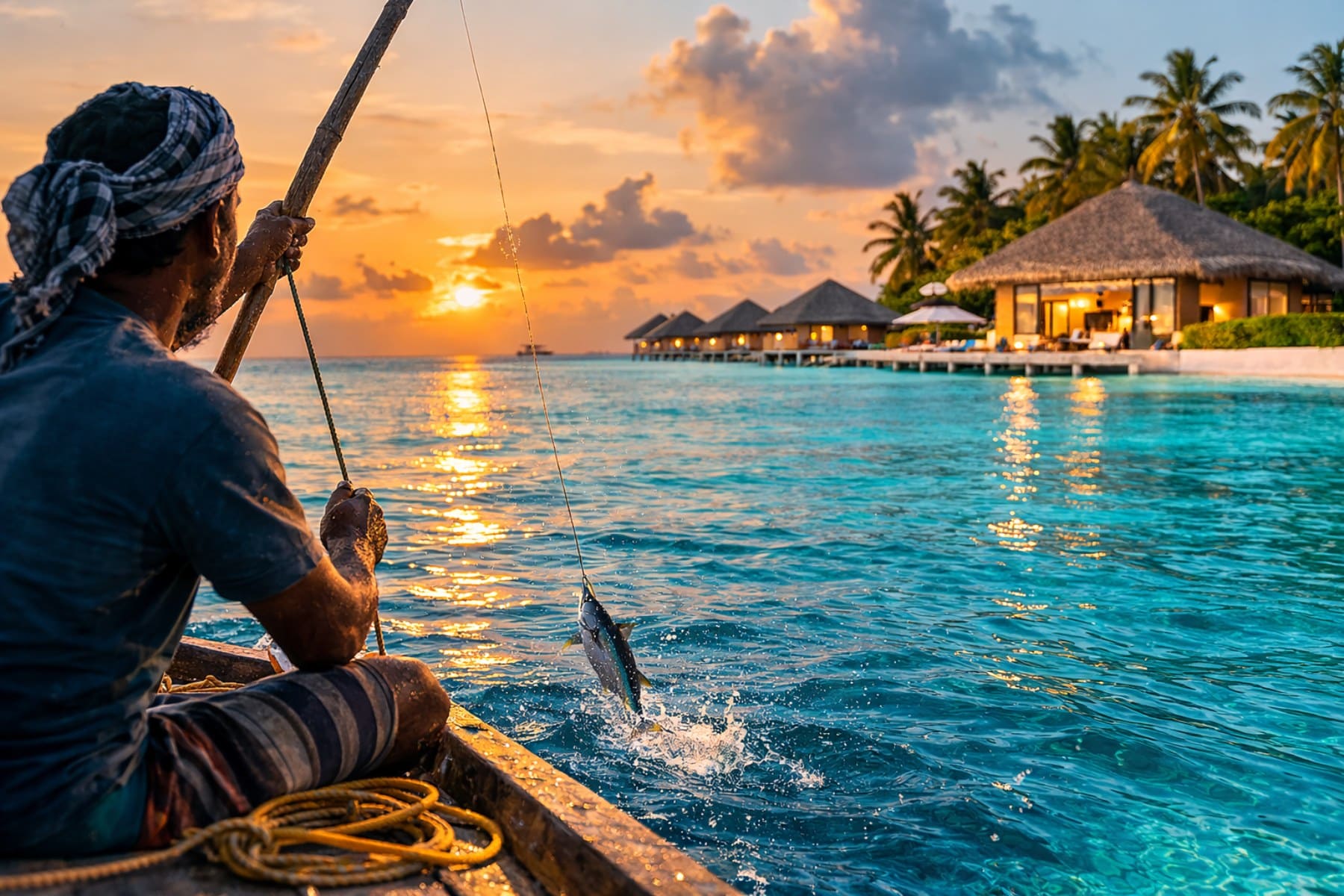
For centuries, the Maldives survived on the sea.
Fishing was not just an industry – it was identity. Tuna shaped diets, trade routes, family life, and the national economy. Wooden dhoanis left at dawn, returning at sunset with the catch that fed both households and export markets.
Then, in the 1970s, something shifted.
Tourism arrived – and with it, a new economic tide.
The Era of Pole-and-Line Fishing
Before resorts and airports, the Maldives was known for its sustainable pole-and-line tuna fishing – a method that required skill, coordination, and physical endurance.
Fishermen stood shoulder to shoulder along the edge of a dhoani, each holding a simple pole. With rhythm and speed, they hauled skipjack tuna one by one from the sea.
No large industrial nets.
No massive trawlers.
Just technique passed down through generations.
Entire island communities revolved around the rhythm of the catch. Fathers taught sons. Boats defined status. The sea defined survival.
Fish – especially dried tuna – was exported across the Indian Ocean long before tourism existed.
The Arrival of Tourism
When the first resorts opened in the early 1970s, few imagined how transformative tourism would become. What began as a modest experiment expanded into a global industry.
White sand beaches and turquoise lagoons – once everyday scenery – became the Maldives’ international brand.
Tourism brought foreign currency, infrastructure development, and rapid economic growth.
Airports expanded.
Resorts multiplied.
Employment diversified.
A New Economic Balance
Today, tourism contributes the largest share of GDP and foreign exchange earnings. Fishing remains a vital sector – particularly tuna exports – but it no longer carries the same economic dominance.
The shift created prosperity – but also exposure to global shocks. Events like pandemics and travel restrictions revealed how dependent the economy had become on visitor arrivals.
Fishing, by contrast, once offered resilience rooted in resource-based independence.
Identity in Transition
Despite the rise of tourism, pole-and-line fishing remains a point of national pride. The Maldives is internationally recognised as one of the most sustainable tuna fisheries in the world.
Even Maldivians working in resorts often come from fishing families.
The Maldives did not abandon fishing.
It expanded beyond it.
Tourism built scale.
Fishing preserved heritage.
Steering the Future
The challenge ahead lies in balance – strengthening sustainable fisheries, enhancing responsible tourism, and diversifying the economy further.
The Maldives once steered by stars and wind.
Today it steers through global markets.
But at its core, it remains a nation shaped by the sea.
Have any thoughts?
Share your reaction or leave a quick response — we’d love to hear what you think!
-
 0
0
-
 0
0
-
 0
0
-
 0
0
-
 0
0
-
 0
0