
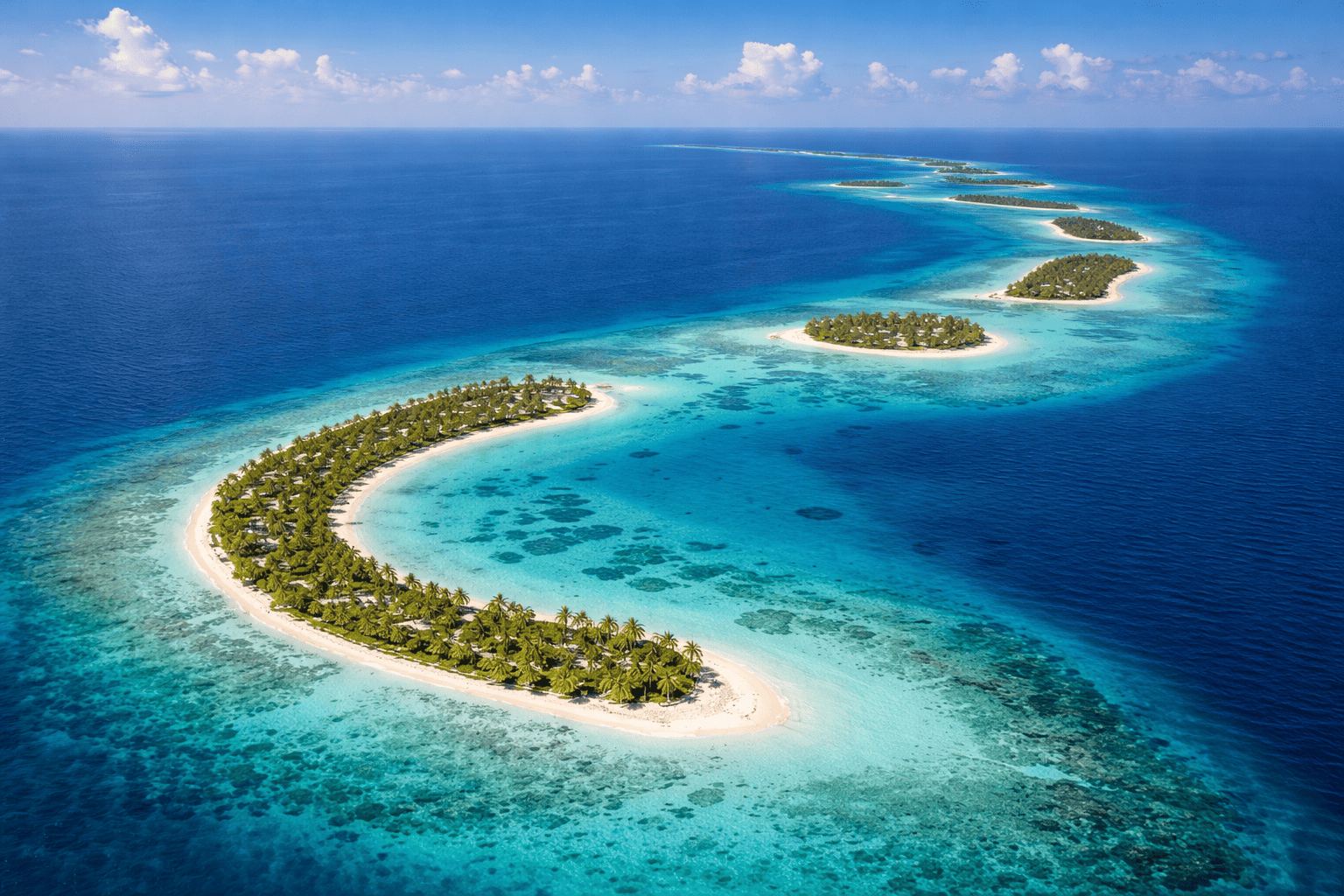
The Maldives is known around the world for its turquoise lagoons and coral islands. But the name “Maldives” itself carries a long history shaped by language, trade, and ancient cultures.
Over centuries, different travelers and civilizations referred to the islands by slightly different names.
The Ancient Sanskrit Origin
One of the most widely accepted explanations comes from Sanskrit, an ancient language used across South Asia.
The name is believed to come from “Maladweepa“:
- Mala – meaning “garland”
- Dweepa – meaning “islands”
Together, the phrase means “garland of islands.”
This description perfectly fits the geography of the Maldives, where hundreds of small islands form long chains across the Indian Ocean.
Names Used by Early Travelers
Throughout history, Arab, Persian, and European travelers wrote about the islands using different spellings.
Arab traders referred to the islands as “Mahal Dibiyat.”
When European explorers arrived later, the name gradually evolved into forms closer to the modern “Maldives.”
These variations reflected how the name was heard and written in different languages.
The Dhivehi Connection
In the local Dhivehi language, the country is called “Dhivehi Raajje.”
This means “the kingdom of the Dhivehi people.”
While the international name Maldives became widely used in global trade and navigation, Dhivehi Raajje remains the traditional name used by Maldivians themselves.
A Name That Traveled the World
Because the Maldives sat along important Indian Ocean trade routes, the islands were known to sailors, merchants, and explorers from many cultures.
The name gradually spread across maps and travel writings, eventually becoming standard in global geography.
Today, the word Maldives represents not just a place, but a chain of islands that has connected cultures and travelers for centuries.
Have any thoughts?
Share your reaction or leave a quick response — we’d love to hear what you think!
-
 1
-
 0
-
 0
-
 0
-
 0
-
 0