
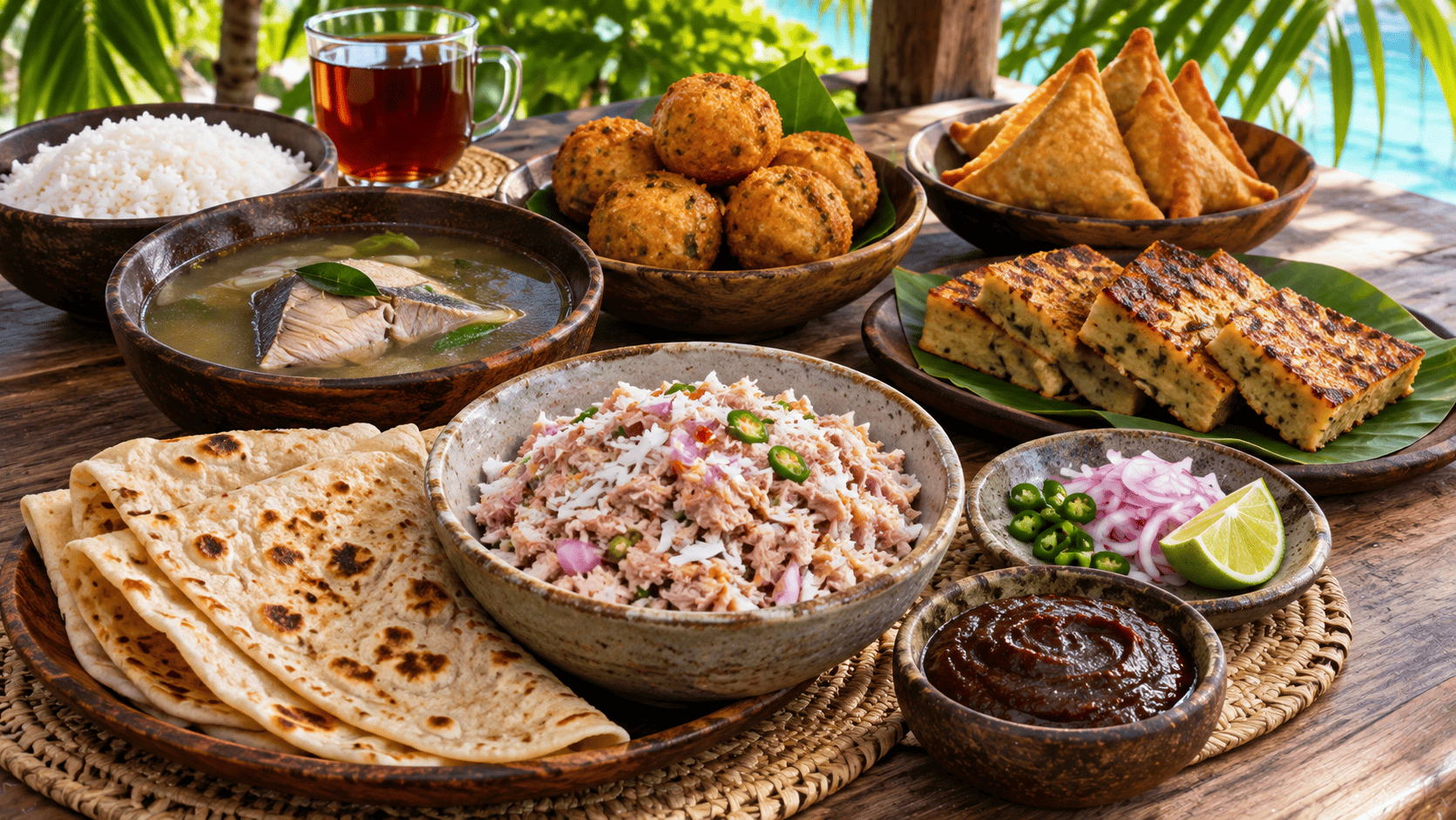
Beyond its beautiful beaches and turquoise lagoons, the Maldives has a rich culinary heritage shaped by the ocean, island traditions and generations of family cooking.
When travellers imagine the Maldives, they often picture white sandy beaches, overwater villas and crystal-clear lagoons.
But there is another experience worth discovering – Maldivian food.
Traditional Maldivian cuisine is built around a surprisingly simple combination of ingredients: tuna, coconut, rice, chilli and locally grown produce.
Over generations, these ingredients have been transformed into distinctive dishes that reflect the country’s maritime heritage, trading relationships and everyday island life.
From freshly prepared breakfasts to spicy fish curries, afternoon snacks and traditional desserts, Maldivian food offers visitors a taste of the culture beyond the resorts.
Here are twelve traditional dishes worth discovering during your Maldives holiday.
1. Mas Huni – The Traditional Maldivian Breakfast
Few dishes represent everyday Maldivian life better than Mas Huni.
This popular breakfast combines finely shredded tuna with freshly grated coconut, onion, chilli and lime juice.
The ingredients are mixed to create a savoury dish with a balance of freshness, spice and rich coconut flavour.
Mas Huni is traditionally eaten with roshi, a soft flatbread similar to a chapati.
It is often accompanied by a cup of hot black tea.
Although the ingredients are simple, Mas Huni remains a much-loved breakfast across the Maldives, from family kitchens to local cafés and resort restaurants.
For visitors wanting to experience an authentic Maldivian morning, this is an excellent place to begin.
2. Garudhiya – The Simple Fish Broth
Garudhiya is one of the most traditional dishes in Maldivian cuisine.
Prepared by boiling fresh tuna in water with salt, this clear fish broth demonstrates the simplicity of island cooking.
Despite its straightforward preparation, Garudhiya has a distinctive flavour and an important place in Maldivian food culture.
It is commonly served with steamed rice, lime, chilli and onion.
Some people enjoy adding other accompaniments, including Rihaakuru.
Garudhiya reflects the close relationship between the Maldivian people and the ocean.
For generations, freshly caught tuna has been central to the country’s food supply, and Garudhiya remains one of its most familiar preparations.
3. Mas Riha – Maldivian Fish Curry
For travellers who enjoy rich flavours and aromatic spices, Mas Riha is worth trying.
This traditional fish curry combines tuna with a carefully prepared mixture of spices, coconut and other ingredients.
Recipes vary between households and islands, with some versions using fresh tuna and others incorporating smoked fish.
The result is a fragrant curry that is commonly served with rice or roshi.
Maldivian curries reflect the country’s historical connections with traders and neighbouring cultures across the Indian Ocean.
Over time, these influences became part of a distinctive local culinary tradition.
4. Rihaakuru – The Rich Taste of Maldivian Heritage
Rihaakuru is one of the Maldives’ most recognisable traditional foods.
It is a thick, dark fish paste produced by slowly reducing tuna cooking liquid until it develops a concentrated flavour and smooth consistency.
The preparation requires patience and careful cooking.
Traditionally, Rihaakuru was valued because it could be preserved and used over time, making it an important part of island food culture.
Today, it remains popular in Maldivian households.
It can be enjoyed with rice, roshi, onion, chilli and lime, or incorporated into other preparations.
Its strong, savoury flavour may be unfamiliar to first-time visitors, but for many Maldivians, Rihaakuru represents the familiar taste of home.
5. Kulhimas – A Spicy Tuna Favourite
Kulhimas is a flavourful tuna preparation known for its rich spices and distinctive taste.
The dish is typically prepared with tuna, onion, chilli and an aromatic mixture of seasonings.
Depending on the recipe, the fish may be cooked with a relatively dry spice mixture rather than a substantial curry gravy.
Kulhimas is frequently enjoyed with roshi or rice.
For visitors seeking something more intensely flavoured than a simple fish broth, it offers a different perspective on traditional Maldivian cooking.
6. Fihunu Mas – Traditional Grilled Fish
With fishing deeply connected to Maldivian culture, it is unsurprising that grilled fish is an important part of local cuisine.
Fihunu Mas refers to grilled fish, often prepared with a mixture of chilli and spices.
The fish is seasoned before being grilled, allowing its natural flavour to combine with the aromatic marinade.
It may be served with rice, roshi or other accompaniments.
For visitors who enjoy seafood, Fihunu Mas offers a simple but memorable way to experience local flavours.
Its preparation also reflects a longstanding relationship between island communities and the fish caught in the surrounding waters.
7. Gulha – The Beloved Maldivian Snack
No exploration of Maldivian cuisine would be complete without mentioning hedhikaa, the traditional snacks enjoyed with tea.
Among the most popular is Gulha.
These small, round snacks are traditionally made using dough filled with a savoury mixture of tuna, coconut, onion, chilli and other seasonings.
They are then fried until golden.
Gulha is commonly served in cafés and enjoyed during afternoon or evening tea.
For many Maldivians, sharing tea and hedhikaa is an important social tradition.
Visitors will often find Gulha alongside several other traditional snacks in local cafés.
8. Bajiyaa – A Crispy and Flavourful Pastry
Bajiyaa is another well-known Maldivian hedhikaa.
Similar in appearance to a small samosa, it is prepared using a thin pastry filled with a savoury mixture.
Traditional fillings commonly include tuna, onion, chilli and aromatic seasonings, although vegetable variations also exist.
The pastry is folded and fried until crisp.
Bajiyaa is a favourite during tea gatherings, family visits and special occasions.
Its combination of crispy pastry and flavourful filling makes it an accessible introduction to Maldivian snacks for international visitors.
9. Kulhi Boakibaa – The Spicy Fish Cake
Kulhi Boakibaa is a traditional savoury cake prepared using rice, tuna, coconut and spices.
Unlike ordinary sweet cakes, this dish is known for its savoury flavour and spicy character.
The mixture is prepared and cooked until firm, then typically cut into portions for serving.
Kulhi Boakibaa is particularly popular as a snack and can be found at tea gatherings and special occasions.
Its preparation reflects traditional Maldivian cooking methods, combining familiar ingredients in a distinctive form.
For travellers interested in authentic island food, it offers a taste that is different from typical international café snacks.
10. Masroshi – Tuna Wrapped in Flatbread
Masroshi combines two familiar ingredients in Maldivian cooking: tuna and roshi.
A savoury tuna mixture, often containing coconut, onion, chilli and other seasonings, is enclosed within dough and cooked on a hot surface.
The result is a filled flatbread that is both satisfying and full of flavour.
Masroshi can be enjoyed as a snack or a light meal.
It is another example of how Maldivian cuisine transforms a relatively small selection of traditional ingredients into a remarkable variety of dishes.
11. Bondibaiy – A Traditional Sweet Celebration
Maldivian cuisine is not limited to savoury seafood dishes.
Traditional desserts also play an important role in family gatherings and celebrations.
Bondibaiy is a sweet rice preparation associated with special occasions and cultural traditions.
It is prepared by cooking rice with sweet ingredients, often including coconut milk or sugar, until it reaches a rich, soft consistency.
Different variations exist across the islands.
Bondibaiy has traditionally been served during celebrations, including occasions associated with the birth of a child.
For many Maldivians, the dish carries memories of family gatherings and shared traditions.
12. Saagu Bondibai – A Sweet Island Dessert
Saagu Bondibai is a traditional dessert made using sago pearls, commonly combined with coconut milk and sweet ingredients.
The small pearls create a distinctive texture, while the coconut contributes richness and flavour.
This dessert is enjoyed during family gatherings and special occasions.
It offers a different side of Maldivian cuisine, demonstrating how coconut and other ingredients are used in both savoury and sweet preparations.
For visitors with a sweet tooth, traditional desserts provide an opportunity to explore Maldivian food beyond its familiar tuna-based dishes.
Where Can Tourists Try Traditional Maldivian Food?
One of the easiest ways to experience traditional Maldivian food is by visiting a local café or restaurant on an inhabited island.
In Malé and Hulhumalé, many restaurants serve traditional dishes alongside other local and international favourites.
Visitors staying at guesthouses on islands such as Ukulhas, Thoddoo, Dhangethi and Dhigurah may also find local cuisine on restaurant menus or through meals arranged by their accommodation providers.
Some resorts feature Maldivian dishes at their restaurants, buffets or themed dining experiences.
For a more authentic experience, visitors can explore local tea shops, sometimes called hotaa, where hedhikaa and tea are a familiar part of daily life.
Menus and availability vary, so travellers interested in particular dishes may wish to ask their accommodation provider for recommendations.
What Makes Maldivian Cuisine Unique?
Maldivian food reflects the country’s geography and history.
Surrounded by the Indian Ocean, island communities have long depended on fish, particularly tuna, as a major source of food.
Coconut trees supplied another essential ingredient, providing coconut flesh, milk and oil for cooking.
Rice, spices and other ingredients arrived through historical trading relationships with neighbouring regions.
Over time, these influences shaped a distinctive culinary identity.
Maldivian cuisine is therefore more than a collection of recipes.
It tells the story of how island communities adapted to limited resources, preserved food and developed traditions that continue to connect generations.
Frequently Asked Questions About Maldivian Food
What is the most famous traditional Maldivian food?
Mas Huni is one of the most recognisable traditional Maldivian dishes, particularly as a breakfast. Garudhiya and Rihaakuru are also important parts of the country’s food heritage.
Is Maldivian food spicy?
Many Maldivian dishes include chilli and aromatic spices, but the level of heat varies between recipes. Visitors who prefer milder food can ask restaurants about ingredients and spice levels.
Is traditional Maldivian food suitable for vegetarians?
Many traditional dishes contain fish, including foods that might not appear to contain tuna at first glance. However, vegetarian dishes and variations are available. Visitors should check ingredients before ordering.
Can tourists try local Maldivian food at resorts?
Yes. Many resorts offer Maldivian dishes through restaurant menus, buffets or themed dining experiences. Local island cafés and guesthouses also provide opportunities to explore traditional cuisine.
Discover the Maldives Through Its Food
A holiday in the Maldives is often remembered for beautiful beaches, turquoise waters and unforgettable marine adventures.
But the country’s food offers another way to connect with its culture.
Every bowl of Garudhiya, every serving of Mas Huni and every plate of freshly prepared hedhikaa reflects generations of tradition.
These dishes are part of the everyday lives of Maldivian families.
They carry the flavours of the ocean, the richness of coconut and the creativity of island communities.
For visitors, trying traditional Maldivian food can transform an ordinary meal into a meaningful cultural experience.
Because to truly discover the Maldives, you should experience not only its islands and oceans, but also the flavours that have shaped life here for generations.
Have any thoughts?
Share your reaction or leave a quick response — we’d love to hear what you think!
-
 1
-
 1
-
 0
-
 0
-
 0
-
 0