
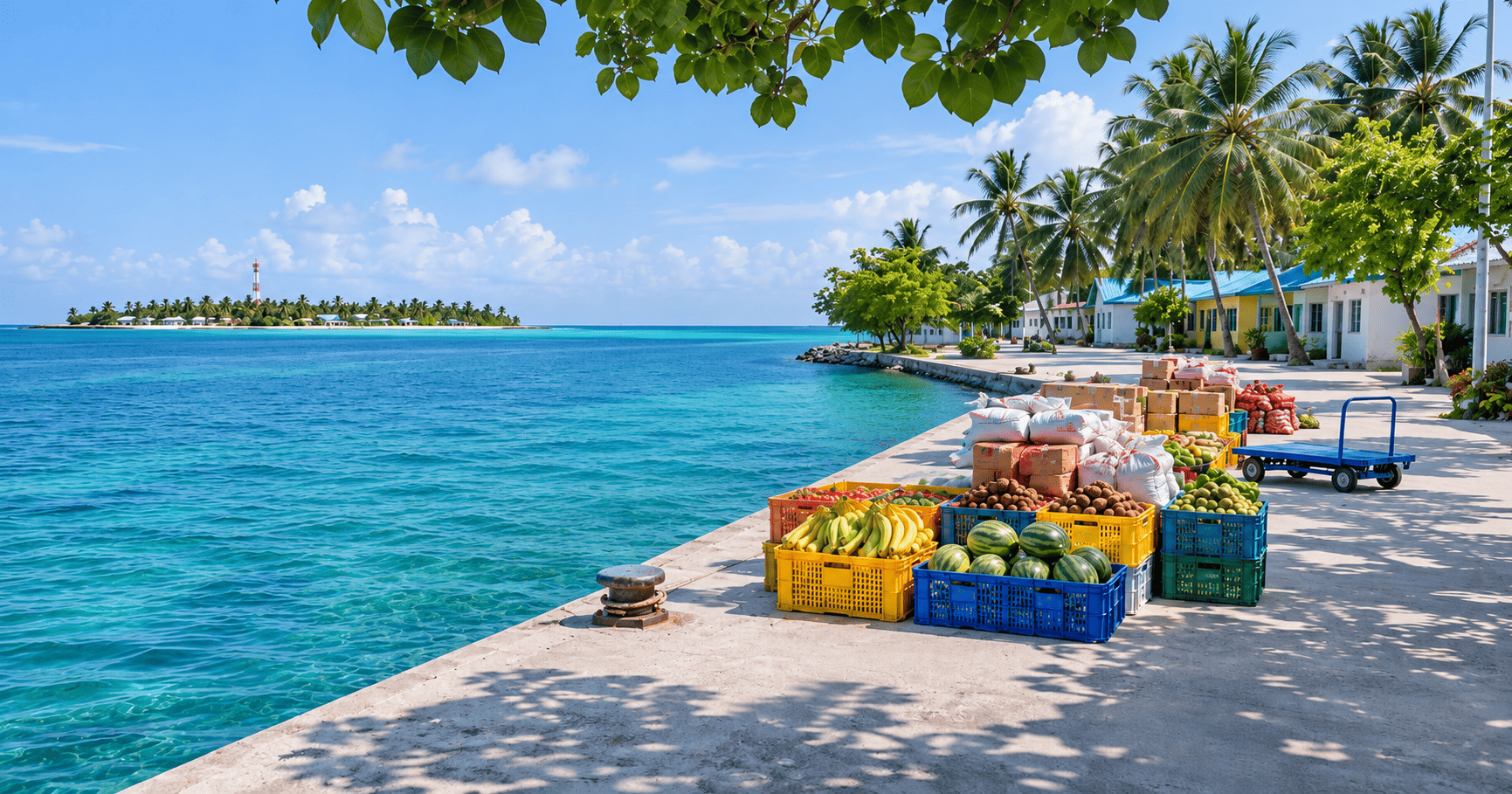
In a nation surrounded by the ocean and heavily dependent on imported food, Maldivian farmers are cultivating something far more important than fruits and vegetables – a more resilient future.
When people think of the Maldives, they imagine turquoise lagoons, white sandy beaches and luxury resorts. Agriculture rarely comes to mind.
Yet beyond the famous coastlines, another side of the Maldives is quietly growing.
Across the islands, farmers cultivate watermelons, papayas, bananas, cucumbers, chillies and an assortment of other fruits and vegetables. Their work may not receive the same attention as tourism or fisheries, but it plays an important role in feeding communities, supporting livelihoods and strengthening the nation’s food security.
In a country where land is scarce and growing conditions can be challenging, every successful harvest represents determination, knowledge and opportunity.
Farming in a Nation of Coral Islands
Unlike countries with vast agricultural plains and extensive freshwater resources, the Maldives faces considerable natural limitations.
Its islands are predominantly composed of coral sand and limestone, with relatively thin soils and limited freshwater availability.
According to the Food and Agriculture Organization of the United Nations (FAO), the Maldives has approximately 27 square kilometres of cultivable land.
For farmers, this means working within an environment where every available piece of land and every source of water matters.
Growing crops requires careful planning, soil management, irrigation and an understanding of seasonal weather conditions.
Despite these challenges, agriculture has remained an important livelihood in several island communities.
From small household gardens to larger agricultural operations, farmers continue to demonstrate that productive farming is possible even under demanding island conditions.
Growing Food Closer to Home
The Maldives depends heavily on imported food.
A 2025 United Nations report estimated that nearly 90 per cent of the country’s food is imported, highlighting its exposure to international supply disruptions and rising global prices.
This dependence creates challenges for a geographically dispersed nation.
Imported food must travel through international shipping networks before reaching the Maldives. From there, products often require additional transportation between islands, involving further costs, storage and handling.
Local agricultural production offers an opportunity to reduce some of this dependence.
When farmers grow fruits and vegetables within the country, they contribute directly to the domestic food supply while creating economic opportunities for island communities.
Fresh produce grown locally can also reach consumers without the lengthy international journeys associated with imports, although efficient domestic transportation remains essential.
The objective is not necessarily to replace all imported food. With limited agricultural land, that would be unrealistic.
Instead, the opportunity lies in producing more of what the Maldives can grow successfully, improving local availability and reducing unnecessary dependence on overseas supply.
The People Behind Every Harvest
Agriculture is not simply about planting seeds and waiting for crops to mature.
Behind every harvest are farmers who prepare land, manage irrigation, monitor plant growth, control pests and diseases, and protect crops from changing weather conditions.
Their work often begins early in the morning and continues throughout the growing season.
Unlike many other economic activities, farming depends heavily on natural conditions that cannot always be controlled.
An unexpected period of heavy rainfall can damage crops. Prolonged dry weather can increase irrigation requirements. Pests, plant diseases and soil conditions can affect productivity.
Nevertheless, farmers continue to cultivate the land because agriculture provides income, sustains communities and contributes to the country’s food supply.
Across the Maldives, agricultural activity takes different forms depending on the island, available land and local experience.
On agricultural islands such as Madidhoo in Shaviyani Atoll, the cultivation of locally grown fruits and vegetables forms part of a wider process involving crop management, harvesting, produce handling and transportation to markets.
These activities demonstrate that successful farming extends beyond the fields themselves.
It requires an entire system connecting production with the people who ultimately consume the harvest.
From the Farm to the Market
One of the greatest challenges facing Maldivian agriculture is not necessarily growing the produce.
It is getting that produce to market efficiently.
Because the country consists of scattered islands, farmers frequently depend on maritime transportation to reach major commercial centres and customers elsewhere.
Fresh fruits and vegetables are particularly sensitive to transportation delays.
Without suitable handling and storage, produce can lose quality before reaching consumers.
This makes logistics an essential part of agricultural development.
Improved transportation, packaging, storage facilities and market connections can help farmers reduce losses and obtain better returns for their work.
Reliable access to buyers is equally important.
Farmers need confidence that the crops they grow can be sold at sustainable prices.
Strengthening the connections between farmers, wholesalers, retailers, resorts and households would help create a more dependable domestic agricultural supply chain.
A New Generation of Farming
Agriculture in the Maldives is also evolving.
Traditional open-field cultivation remains important, but modern technologies offer opportunities to improve productivity while using limited resources more efficiently.
Hydroponics, drip irrigation, protected cultivation and improved growing media are increasingly being explored as solutions to the country’s agricultural constraints.
These methods can help reduce water consumption, improve growing conditions and manage some of the risks associated with pests and environmental exposure.
In January 2026, a solar-powered hydroponic farm was inaugurated in Raa Atoll’s Vaadhoo, demonstrating how renewable energy, water management and modern cultivation techniques can be combined to support local food production.
Such initiatives represent encouraging progress.
However, technology alone cannot transform agriculture.
Farmers also require training, reliable markets, suitable infrastructure, affordable inputs and long-term investment.
A sustainable agricultural sector depends on combining practical farming experience with appropriate modern solutions.
Farming and Environmental Responsibility
Agricultural development must also recognise the fragile nature of the Maldivian environment.
Freshwater resources are limited, and groundwater can be affected by salinity and contamination.
Poorly managed fertiliser and pesticide use can damage soil and surrounding ecosystems.
Climate change introduces additional challenges, including changing rainfall patterns, higher temperatures and the risk of saltwater intrusion.
Responsible farming practices are therefore essential.
Efficient irrigation, soil improvement, integrated pest management, organic waste composting and appropriate crop selection can help reduce environmental pressures.
The aim should be to increase agricultural productivity without compromising the natural resources that make farming possible.
For a small island nation, agricultural sustainability and environmental protection must progress together.
An Opportunity for the Next Generation
The future of Maldivian agriculture also depends on attracting new people into the sector.
For younger generations, farming may not always appear as attractive as careers in tourism, business or technology.
Yet agriculture offers opportunities in entrepreneurship, agricultural technology, production management, distribution and food processing.
Modern farming is increasingly connected to innovation, data, logistics and business development.
With the right support, young Maldivians could contribute new ideas while learning from the experience of established farmers.
Encouraging this exchange of knowledge is important for sustaining agricultural activity over the long term.
Cultivating a More Resilient Maldives
In September 2026, the Government of Maldives and FAO launched a five-year initiative focused on strengthening climate-resilient agricultural food systems.
The initiative reflects growing recognition that agriculture has an important place in national development and food security.
The Maldives will continue to depend on international trade, and imported food will remain essential.
But greater domestic production can strengthen the country’s ability to respond to economic uncertainty, transportation disruptions and changing global conditions.
Every field cultivated, every crop harvested and every local supply chain strengthened contributes to that objective.
Agriculture may never become the Maldives’ largest industry.
Its importance, however, should not be measured only by its contribution to the economy.
It should also be measured by the livelihoods it sustains, the food it provides and the resilience it helps build.
The future of the Maldives is not shaped only by what happens at sea. Part of that future is growing quietly in the soil beneath our feet.
Have any thoughts?
Share your reaction or leave a quick response — we’d love to hear what you think!
-
 0
-
 0
-
 0
-
 0
-
 0
-
 0